

This page was translated from Dutch with AI.
From unrest to collaboration
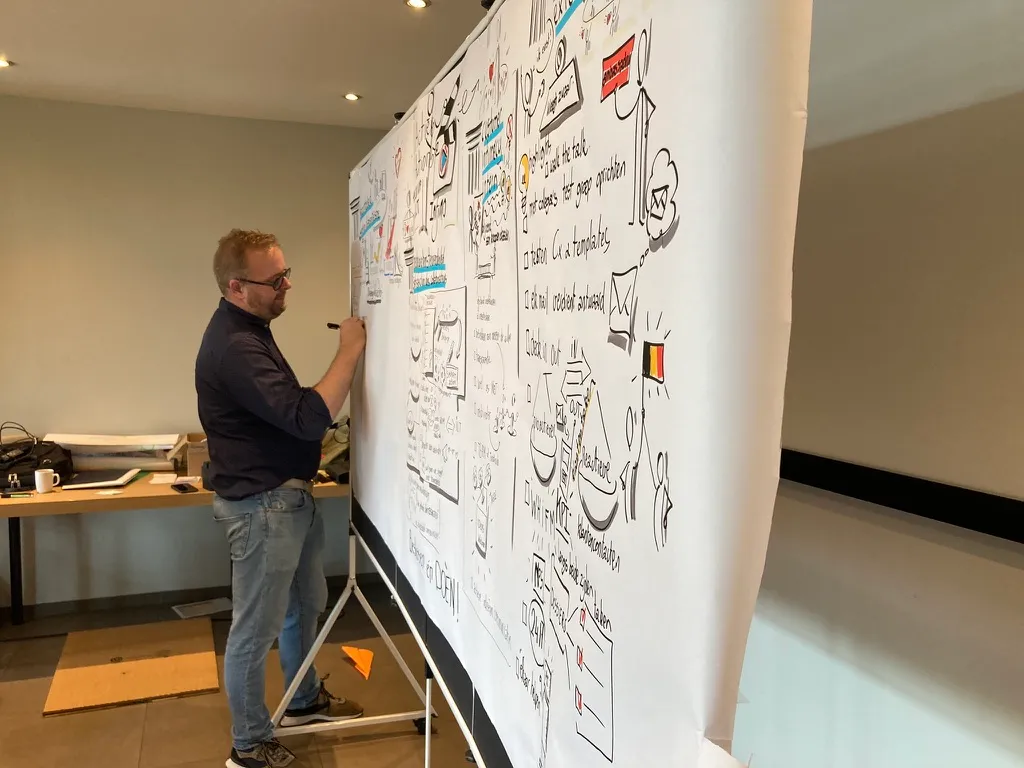
Short answer: Visual facilitation turns unrest into collaboration. During a two-day session for a management team, we captured ideas live on a large board, which turned a discussion about KPIs into a shared picture and a concrete action plan. This way, people feel heard and grow as individuals and as a team.
What was at stake?
It was going to be a two-day session where everything was at stake. The CEO was determined: "I want us to do more than just talk. We need concrete output, an action plan that gives us direction for the coming years." Her concern was obvious.
Her goal was a shared vision for 2025 and a management team that presented itself as a united front. Her challenge: the team partly consisted of new members, there were sensitive themes at play and a few critical voices questioned the course of the organisation.
This was not just an exercise. It was a moment of truth.
What was the CEO worried about?
From the first preparation talks, she was clear: "I do not want a talking shop, I want concrete results. People need to know what they have to do after this session."
She feared that the hot topics, subjects that often cause tension, would dominate the session and drain the energy from the team. She also expected concrete output, preferably as visual as possible.
Our task was not to provide solutions, but to facilitate the way to those solutions. The key lay in the process: not the what, but how we would conduct the conversations, would make the difference.
How do you prepare for such a session?
Even before the two-day session started, we spoke in depth with each of the managers. Which themes did they want to bring forward? What were their concerns and desired outcomes? And how do we ensure that everyone is not only heard, but that concrete steps also emerge from it?
We worked with a variety of methods, from interactive exercises to visualisations, so that the team stayed involved and focused.
Even with the best preparation, you always encounter something unexpected. Karl and I often say: "You have to have prepared and you have to be prepared!" And those unexpected twists did happen.
What happened at the critical moment?
At a certain point, a discussion threatened to get bogged down in complaining and bickering about KPIs. I saw an opportunity to get everyone on the same page, without adding a single word. While it went back and forth, we captured the ideas visually on a large board. The effect was almost immediate.
Where the energy had drained away into differing opinions and interests a few moments earlier, a shared picture now emerged. Everyone looked at the same thing and saw the connections. What seemed abstract and elusive became tangible and clear.
That is not a magic trick, but the power of visual facilitation. It gives direction to the conversation and brings everyone on the same page, without anyone seeing their ideas get lost. The critical voices turned into constructive contributions. Where scepticism first prevailed, we now saw involvement and energy.
How do you go from discussion to action?
During the visual facilitation, we kept focusing on one question: "What can we concretely do with this?" This way, the energy shifted from frustration to action and every form of resistance became a contribution to the final goal.
At that moment, everyone in the team worked together towards something bigger.
What does collective learning yield?
The entire team worked together and did not avoid critical points. That led to a concrete action plan. Furthermore, people learned from each other. They felt heard and grew as individuals and as a team.
That is the power of facilitation: it helps to make decisions and ensures that people become stronger together. At The House of Coaching, we believe that the real value lies in promoting individual and collective learning and development.
How to apply it
- Speak with each participant beforehand about themes, concerns and desired outcomes.
- Choose a variety of methods, from interactive exercises to visualisations.
- Capture ideas visually during a discussion, so that everyone looks at the same picture.
- Always ask the question: what can we concretely do with this?
- Conclude with a concrete action plan.
Do you want to experience for yourself how facilitation can strengthen your team? Discover how you turn team meetings into inspiring, action-oriented sessions in our training Facilitation. Online and hybrid facilitation and our book Facilitation is a game! will also help you further.
About the author
Steff Vanhaverbeke is a business coach, trainer and facilitator and has been giving training in 21st Century Skills since 1997. She is co-author of the book Facilitation is a game!.
Frequently asked questions
In visual facilitation, you visibly capture ideas during a conversation, for example on a large board. Everyone then looks at the same picture and sees the connections. That gives direction to the conversation and brings everyone on the same page.
Capture the differing ideas visually and keep asking the question what you can concretely do with them. This way, the energy shifts from frustration to action and critical voices become constructive contributions.
In our Facilitation training, you learn to turn team meetings into action-oriented sessions. Do you want it for your team or tailor-made? Then get in touch via the contact page, and we will look together at what fits.