

This page was translated from Dutch with AI.
How do you make your meetings more energetic?
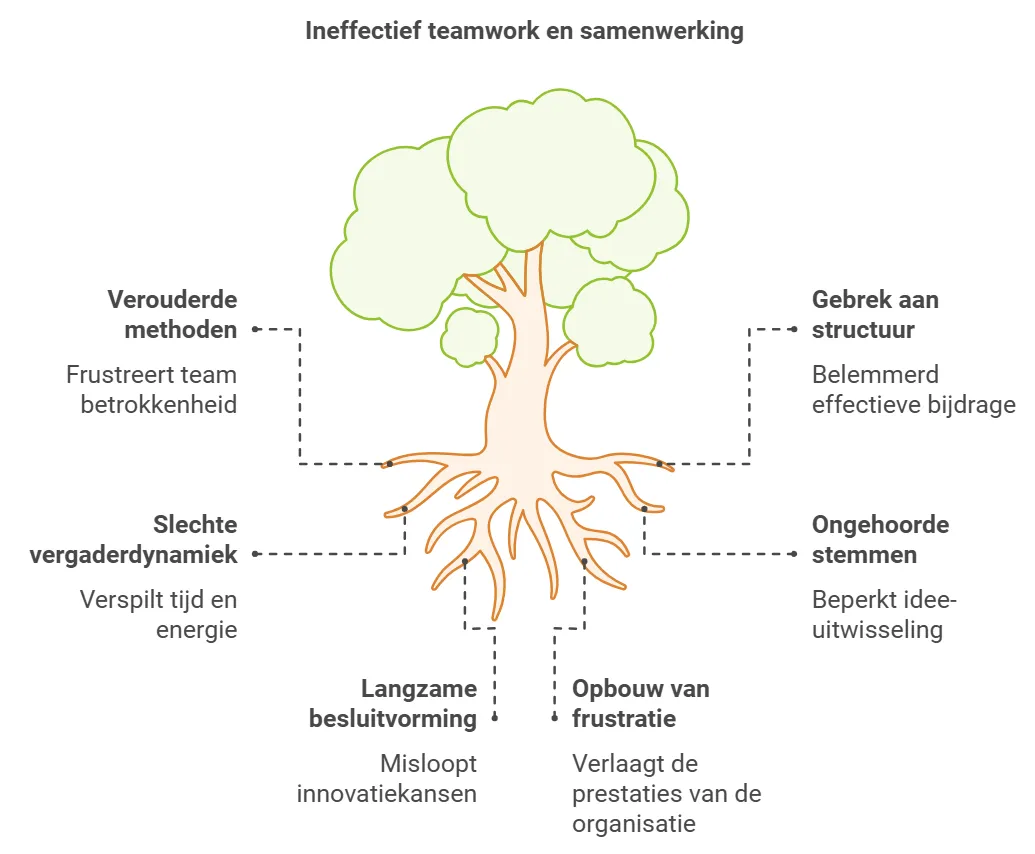
Short answer: meetings become more energetic when you organise them differently: with a good structure where everyone's input counts, instead of rigid schedules or endless discussions. That is facilitation, and you can learn it. This way, you use your team's potential and good ideas do not get left behind.
Do you notice that meetings drain your energy instead of giving you energy? That your real talents and ideas often remain unused? And how many good projects fail due to a lack of collaboration, frustration or a lack of clarity?
You are not alone. A great many teams struggle with dull meetings, faltering collaboration and a growing pile of missed opportunities. While most organisations want to work like a well-oiled machine, want to innovate and want to grow. And people want to contribute, offer added value and deliver engaging and meaningful work.
Why do things often stall in teams and organisations?
The problem does not lie with the people themselves, and usually not with their skills either. What is often missing are the right methods and structures to let everyone contribute in an effective way.
Traditional meeting and consultation methods, such as rigid schedules or endless discussions without a clear direction, do not match what we really need today: collaborating with an eye for everyone's input, ideas and perspectives.
What does it cost if you keep doing what you always did?
Those who continue to work with outdated methods will naturally experience frustrations. People who do not feel heard or involved prefer to keep their ideas to themselves. Meetings become sluggish, decision making is slow and good ideas do not get further than the whiteboard.
Recognisable? Collaborating and consulting, too rigid or too chaotic, makes it difficult to truly involve people. Opportunities are lost and people get stuck in a work environment where they cannot share or develop their best ideas.
Time, money and energy are wasted and afterwards extra effort is needed to fix problems. The result is frustration, an organisation that performs below its level and missed opportunities for innovation and growth.
What changes when you learn to facilitate?
Facilitation is about a work environment where everyone's input counts and where people truly collaborate. You simply organise your meetings and decision making in a different way.
It gives you practical tools to create support, solve problems, brainstorm creatively and learn more easily. These techniques are easy to learn and applicable at any level. You do not need years of training or special skills for it.
This way, you use the full potential of your team and change how you collaborate. Not with rigid control, but with the power of a good structure.
In a world where complexity and diversity continue to increase, effective collaboration only becomes more important. Facilitation techniques offer the practical, no-nonsense tools to achieve that.
This is how you apply it
- Look critically at your next meeting: does it have direction, and does everyone get a turn?
- Replace the rigid schedule or the open discussion with structure: a working method in which every contribution counts.
- Learn the techniques: they are easy to learn and every participant can apply them.
Discover more in our book Facilitation is a game!, written by Steff Vanhaverbeke and Karl Mortier, with inspiring techniques and practical insights that you can apply immediately. Curious about our training courses on this theme? View Facilitation. Join our growing community of facilitators.
About the author
Steff Vanhaverbeke is a certified business coach, trainer and facilitator. She has been giving training courses in 21st Century Skills since 1997.
Frequently asked questions
Usually it is not down to the people or their skills, but to the methods. Rigid schedules or endless discussions make people feel unheard, causing them to keep their ideas to themselves and making meetings sluggish.
No. The techniques are easy to learn and applicable at any level. Everyone can learn and apply them. With a good structure, you use the full potential of your team.
In the training course Lead meetings and workshops effectively you practise with a coach from THOC. Are you looking for a programme for your own team? Then get in contact, and we will tailor it to your needs.