

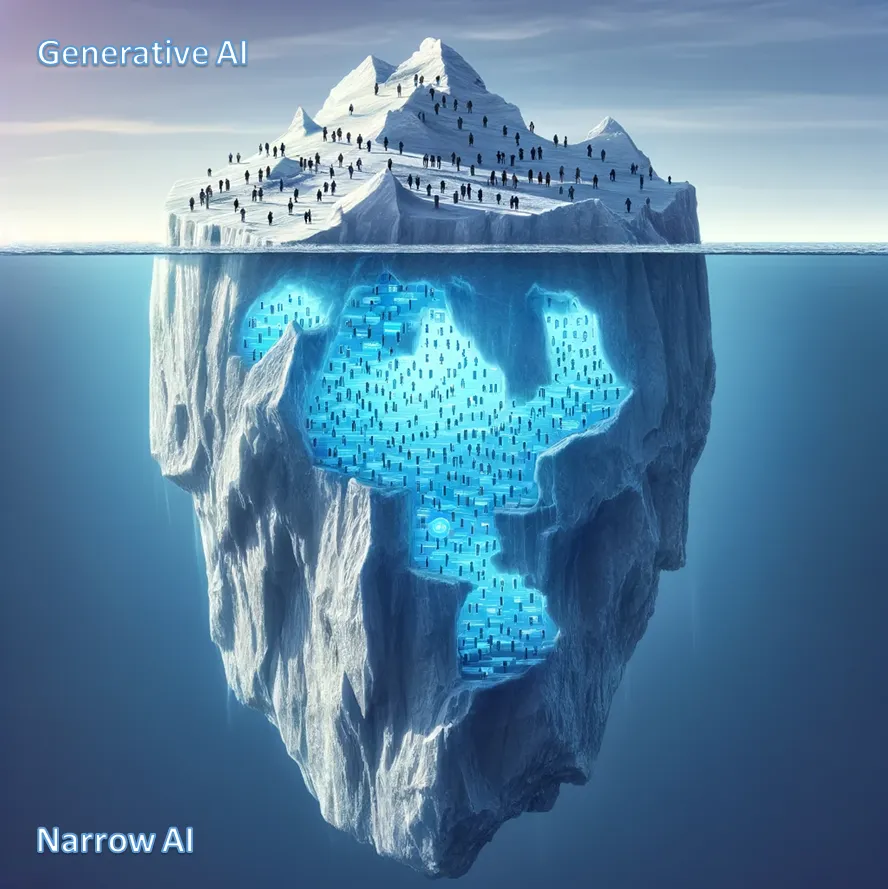
Narrow AI (Weak AI)
Narrow AI refers to AI systems that are designed and trained to perform a specific task. These systems are "narrow" or "weak" because their intelligence and learning capacity are limited to the specific domain for which they are programmed. They cannot operate outside that framework or learn new tasks without additional programming or training.
- Examples: Chatbots designed for customer service, facial recognition systems, and recommendation systems like those used by Netflix or Amazon. There are numerous other applications that we use almost daily without realising that "Narrow A.I." is behind them. Just think of:
- Speech Recognition in Smartphones: Systems like Siri on iPhones, Google Assistant on Android devices, and Bixby on Samsung smartphones. These AIs can understand speech and respond based on pre-programmed commands.
- Recommendation Systems: Used by online platforms like Netflix, Spotify, and Amazon to recommend products, films, or music based on your previous preferences and behaviour.
- Email Spam Filters: AI in email services like Gmail or Outlook that automatically filter spam and unwanted emails based on certain characteristics.
- Customer Service Chatbots: Many companies use chatbots on their websites or in customer service apps to answer customer questions and provide support.
- Facial Recognition: Applied in smartphones for unlocking or by social media platforms like Facebook for tagging photos.
- Narrow AI in Navigation Apps: Such as Google Maps and Waze, which analyse traffic patterns and suggest the fastest route to your destination.
- Banking and Fraud Detection: AI systems used by banks to recognise unusual activities on your account and detect potentially fraudulent transactions.
- Smart Assistants in Household Appliances: For example in smart thermostats like Nest, which learn from your preferences and automatically adjust the temperature in the house.
- Automatic Translation Services: Such as Google Translate, which translates texts between different languages.
- Automatic Content Moderation: Used by social media platforms like Instagram and YouTube to scan and filter content for inappropriate or harmful material.
- Medical Imaging: AI that compares ideal X-ray images with those of patients and thus supports doctors in their decision-making.
- Characteristics of Narrow AI are:
- Specialisation: The AI is trained for a very specific purpose, for example analysing medical images.
- Based on Training Data: The ability of the AI to be deployed depends on the quality and diversity of the training data on which the system is trained.
- No General Intelligence: These systems cannot function outside their training. For example, they cannot be used for other types of tasks without additional training.
- Decision Support: In medical imaging, for example, Narrow AI systems are often used as supporting tools to help doctors make decisions, but they generally do not replace the clinical assessment of a specialised doctor.